A Strategic White Paper for CFOs and Finance Leaders
Author: Dr. Veera Nallam, PhD, Founder & CIO, ARSYNC INC
Executive Summary
Enterprise finance businesses have invested significantly in ERP platforms, automation technologies, and analytics dashboards. However, many CFOs continue to face challenges with cash flow predictability, working capital efficiency, dispute resolution, and regulatory compliance.
Systems and data deficiencies are not the primary issue. The primary challenge is a lack of governance, orchestration, and integrated intelligence.
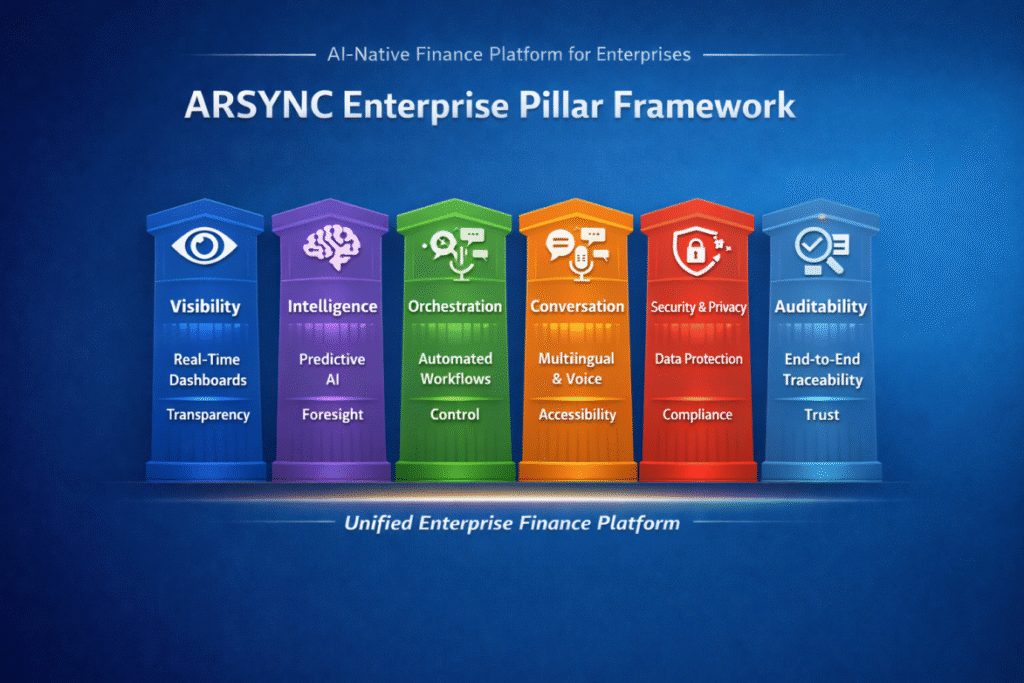
This white paper outlines ARSYNC’s AI-Native Finance Platform, which is built upon six core pillars:
- Visibility
- Intelligence
- Orchestration
- Conversation
- Security & Privacy
- Auditability
These pillars work together to transform fragmented finance environments into unified, intelligent operating systems.
1. The Current State of Enterprise Finance
Most finance organizations operate in complex technology landscapes that include:
- Multiple ERP platforms
- CRM platforms
- AR/AP tools
- Treasury systems
- Contract repositories
- Compliance portals
- Reporting dashboards
- Cloud-based applications
These systems help you see what’s happening, but they don’t work together well.
As a result:
- Cash flow remains unpredictable.
- Disputes are escalated manually.
- Forecasts often lack credibility.
- Knowledge remains siloed.
- Compliance depends on people.
Finance teams end up spending more time on processes than on results.
2. Why Traditional Automation Falls Short
Traditional finance automation focuses on:
- Task execution
- Rule-based workflows
- Static reporting
- Manual input and extraction to feed another system
- No single version of truth and a hierarchy of competing systems
These methods make things more efficient, but they often don’t work as well as expected.
When exceptions arise, such as disputed invoices, changing contract terms, delayed payments, or regulatory requirements, tasks revert to manual handling.
The system itself does not:
- Learn
- Adapt
- Prioritize
- Orchestrate
This puts limits on how much the system can grow and how well it performs.
3. The ARSYNC AI-Native Finance Platform
ARSYNC introduces a new approach: AI-Native Finance Operations.
Instead of just adding tools to ERP systems, ARSYNC builds intelligence, control, traceability, accountability, and automation right into finance processes. It acts as a smart layer for the business that brings together:
- Data
- Documents
- Decisions
- Execution
- Compliance
The platform is based on six connected pillars. ARSYNC enables AI-native finance by combining real-time visibility, predictive intelligence, automated orchestration, conversational access, data protection, and end-to-end auditability into a unified enterprise platform.
4. The Six Pillars of AI-Native Finance
ARSYNC is built around six core pillars of excellence that reflect how finance really works in practice. Each addresses a common challenge finance teams face every day. Together, they create a strong foundation for running finance with clarity, confidence, and control.
Visibility: Real-Time Financial Transparency
ARSYNC provides real-time access to unified dashboards for:
- Accounts receivable
- Accounts payable
- Cash positions
- Disputes
- Forecasts
- Re-baselining
Finance leaders get a single, accurate view of data across all locations, departments, and systems. This foundation ensures:
- Accurate reporting
- Decisions can be made faster
- Less reliance on manual consolidation
- Bi-directional synchronization
Being able to see everything clearly is the basis for smart finance.
Intelligence: Predictive Financial Foresight
ARSYNC uses AI and advanced analytics to review financial data and spot patterns, risks, and opportunities. Capabilities include:
- Payment behavior prediction
- Dispute risk detection
- Cash flow forecasting
- Credit risk assessment
- Revenue leakage identification
CFOs get a clearer view of what’s ahead, rather than just looking back at past data. This helps them manage working capital and risks before problems arise.
Orchestration: Automated Financial Execution
ARSYNC helps coordinate financial workflows across different systems and teams. It enables:
- Automatic collection prioritizing
- Dynamic payment scheduling
- Exception routing
- Dispute resolution workflows
- Policy-based execution
The platform dynamically changes workflows based on real-time data, business needs, and market conditions. This allows finance teams to focus less on tasks and more on delivering the best results.
Conversation: Multilingual, Voice-Enabled Interface
Users can interact with ARSYNC in plain language, by typing or speaking, and in multiple languages, across finance systems, support platforms, legal documents, compliance repositories, and internal knowledge bases.
They can inquire about:
- Financial performance
- Invoice status
- Contract terms
- Compliance procedures
- Internal policies
ARSYNC provides a single conversational interface for enterprise finance. Examples:
- “Which customers are likely to delay payments?”
- “What are the terms in the specific SOW?”
- “Show disputes affecting this quarter’s cash flow.”
This makes learning easier, more accessible, and helps people make decisions faster.
Security & Privacy: Enterprise-Grade Protection
The foundation of ARSYNC is privacy and security. Key capabilities include:
- Zero-Trust architecture
- Role-based access restriction
- End-to-end encryption
- Data masking and redaction
- Processing data within an enterprise IT environment
Data security comes first, and sensitive financial and personal information is protected at every step. All transactions comply with enterprise security rules and standards, including GDPR, SOX, COBIT, SOC 2, NIST AI RMF, and ISO.
Security is part of the foundation, not an afterthought.
Auditability: End-to-End Traceability
The ARSYNC system ensures you can track everything from understanding to decisions and actions. Each activity includes:
- Source data references
- Decision logic
- User context
- Timestamps
- Approval records
This allows for:
- Explainable AI
- Automated audit evidence
- Regulatory defensibility
- Continuous compliance monitoring
Everything is transparent. Finance leaders can easily show how results were reached.
5. Platform Architecture
ARSYNC works as a smart layer on top of your current systems. It integrates with:
- ERP platforms
- CRM systems
- Billing tools
- Document repositories
- Compliance systems
The architecture includes:
- Multi-agentic AI services
- Secure data pipelines
- Orchestration engines
- Governance frameworks
This allows organizations to upgrade their intelligence without replacing their core systems.
6. Business Impact for CFOs
Typically, organizations that deploy ARSYNC experience:
- Accelerated working capital cycles
- Enhanced forecast reliability
- Decreased volume of disputes
- Lower operating expenses
- Stronger regulatory posture
- Higher financial productivity
The benefit is derived from major structural improvements rather than minor automation steps. You can see benefits instantly, and they continue to grow over time.
7. Strategic Value for Finance Leadership
The table below shows how ARSYNC changes the day-to-day reality of finance leadership.
From Traditional Finance to AI-Native Finance
| Area of Leadership | Before ARSYNC | With ARSYNC | What This Means for You |
|---|---|---|---|
| Decision Making | Based on past reports and manual reviews | Driven by real-time insights and predictions | You make faster, more confident decisions |
| Cash Management | Constantly monitoring balances and delays | Predicting and managing cash flow proactively | Fewer surprises, better planning |
| Risk Management | Discovering issues after they happen | Identifying risks early | Less firefighting, more control |
| Team Coordination | Dependent on emails, meetings, and follow-ups | Coordinated automatically by the system | Higher productivity, less stress |
| Forecasting | Periodic and spreadsheet-heavy | Continuously updated and system-driven | Forecasts you can trust |
| Compliance | Preparing for audits after the fact | Compliance built into daily operations | Fewer audit issues |
| Knowledge Sharing | Reliant on key individuals | Embedded in the platform | Less dependency on specific people |
| Strategic Focus | Solving operational problems | Driving growth and optimization | More time for leadership |
ARSYNC helps finance leaders move from:
- Chasing data → Acting on insight
- Managing tasks → Managing outcomes
- Reacting to issues → Preventing them
- Coordinating people → Coordinating systems
- Enforcing rules → Embedding governance
Finance becomes a strategic part of the business, not just a support function.
8. Why ARSYNC Is Different
Not Just Another Finance Tool
Most finance tools focus on one area:
- Reporting
- Automation
- Collections
- Analytics
ARSYNC brings everything together. It combines:
- ✔ Visibility
- ✔ Intelligence
- ✔ Orchestration
- ✔ Conversation
- ✔ Security
- ✔ Auditability
in one unified platform.
With ARSYNC in place, finance leaders typically experience:
More Time for Strategic Work
Routine monitoring, follow-ups, and exception handling are automated. Spend less time managing details and more time shaping strategy.
More Predictable Outcomes
Cash flow, collections, and forecasts become more reliable. Planning becomes easier. Surprises become rare.
Stronger Governance
Controls, approvals, and audit trails are built into the system. Compliance becomes part of everyday operations, not a separate effort.
Easier Scaling
As the business grows, finance operations grow with it, without adding unnecessary headcount.
Higher Credibility
When numbers are accurate and your forecasts are reliable, trust in the board, investors, and leadership increases.
9. Conclusion
The future of enterprise finance isn’t just about faster processing or more reports. Instead, it will be defined by:
- Intelligence
- Coordination
- Trust
- Accountability
ARSYNC’s six-pillar AI-Native Finance Platform brings this vision to life. By combining intelligence, conversation, security, auditability, orchestration, and visibility into a single system, ARSYNC turns finance into a key driver of business growth and resilience.