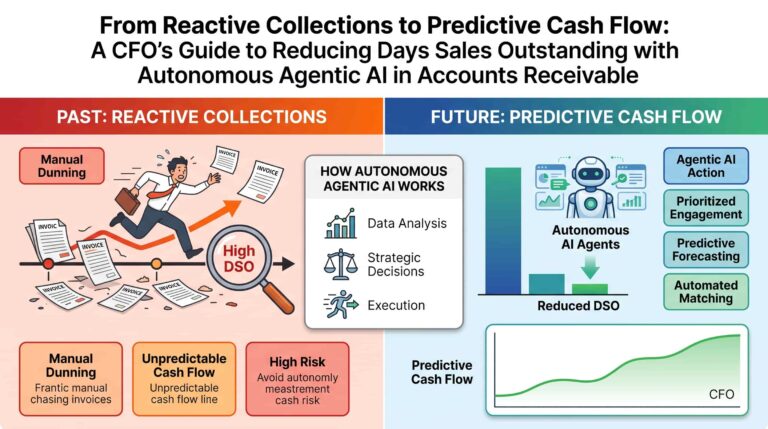
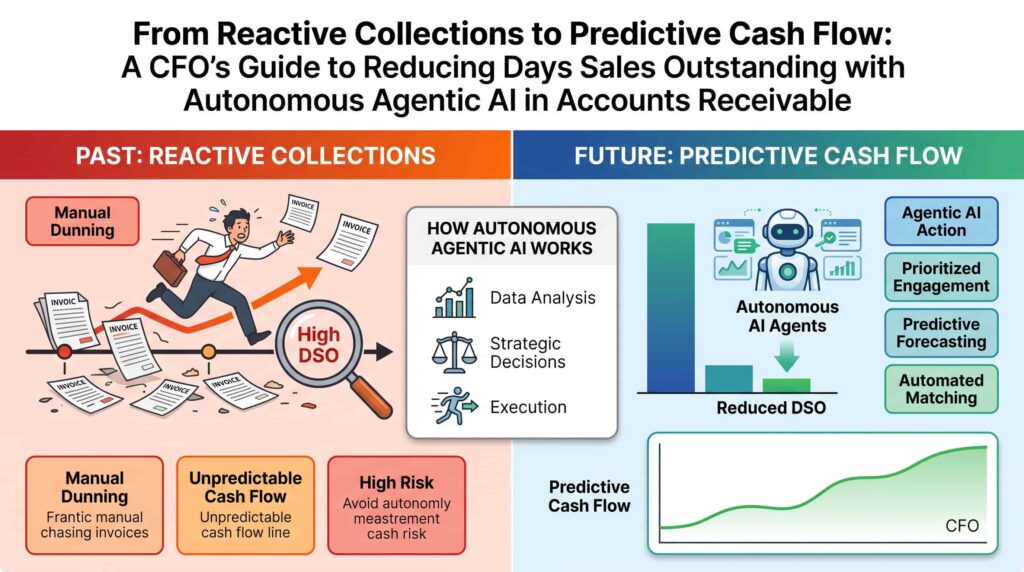
Days Sales Outstanding (DSO) has long been the stubborn, defining metric of the finance department. Despite ERP upgrades and digitized invoicing, most Accounts Receivable (AR) teams remain trapped in a reactive cycle: issue the invoice, wait for the due date, and then scramble to chase down delinquent payments. This look-back approach ties up working capital, increases bad debt exposure, and strains client relationships through generic, aggressive dunning campaigns.
Autonomous agentic AI is actively replacing this outdated model. By shifting AR from a defensive collection mechanism into a predictive, self-optimizing engine, CFOs are unlocking trapped liquidity without adding headcount.
The Limitation of Traditional Dunning
Standard collection software relies on rigid, rules-based logic. On day 31, the system sends Template A. On day 45, it sends Template B. This approach ignores the nuance of B2B relationships. It treats a chronically late Fortune 500 client with complex procurement rules exactly the same as a small business facing temporary cash flow friction.
Worse, reactive collections wait for the failure to occur. By the time human AR specialists intervene on day 45, the invoice is already entangled in a dispute, a missing PO, or a budget freeze, guaranteeing that the cash will not arrive for weeks.
| Capability | Traditional Collections | Agentic AI Collections |
| Action Trigger | Invoice crosses past-due threshold (Reactive) | AI predicts delay risk pre-due date (Predictive) |
| Outreach Strategy | Static, scheduled template emails | Context-aware, dynamically generated messaging |
| Dispute Resolution | Manual investigation and cross-department routing | Autonomous contract/PO/invoice reconciliation |
| Cash Forecasting | Based on historical averages and static terms | Real-time probability scoring at the invoice level |
| Human Role | Data entry, manual email drafting, chasing | Strategy, relationship management, complex escalations |
What is Agentic AI in Accounts Receivable?
Unlike basic Robotic Process Automation (RPA) or standard generative AI chatbots, agentic AI operates with goal-oriented autonomy. You give the agent a directive—such as “minimize DSO for this customer segment while maintaining a positive relationship”—and the agent determines the necessary steps to achieve it.
These autonomous agents can read incoming emails from accounts payable departments, understand the context of a delay (e.g., “We are waiting on internal approval,” or “Line item 3 doesn’t match our contract”), and take independent action to resolve the blocker. They interact directly with the client, query internal ERP systems, and update the CRM without human supervision.
Mechanisms for Driving Down DSO
Deploying autonomous agents fundamentally alters how cash flows into the business, impacting the entire order-to-cash lifecycle.
- Predictive Delinquency Scoring: Agentic AI analyzes historical payment patterns, seasonality, macro-economic indicators, and recent email sentiment to predict which invoices are likely to be paid late. Instead of waiting for day 31, the agent might send a gentle, personalized check-in on day 25 to ensure the client has everything they need for processing.
- Contextual Autonomous Outreach: An agent customizes the tone, channel, and timing of communication based on what works best for a specific buyer. If a buyer consistently pays only after receiving an itemized statement on a Thursday, the agent will autonomously generate and send that exact package on Wednesday afternoon.
- Real-Time Dispute Triage: When a client emails back stating they are short-paying an invoice due to a volume mismatch, the agent instantly cross-references the original contract and the delivery log. If the client is correct, the agent can autonomously draft a credit memo for human approval. If the client is wrong, the agent politely replies with the supporting documentation attached, preventing a multi-week delay.
- Promise-to-Pay Automation: When a client promises to pay on a specific date, the AI extracts that commitment, updates the cash flow forecast in the ERP, and sets an internal trigger. If the date passes without the wire clearing, the agent immediately initiates a follow-up specific to that broken promise.
The Strategic Shift for the Finance Team
Integrating agentic AI requires a shift in how finance leaders deploy their human capital. When agents automate 80% to 90% of routine follow-ups, reconciliation, and basic dispute handling, the AR team is elevated from tactical debt collectors to strategic credit managers.
Humans are redirected to manage the critical 10%: high-risk accounts, complex contract renegotiations, and deep relationship building with key enterprise accounts.
Transitioning to predictive cash flow is no longer a matter of simply upgrading a software interface. CFOs who leverage autonomous agents are effectively deploying a tireless, infinitely scalable digital workforce that secures earned revenue faster, sharpens cash flow forecasting, and turns the AR department into a definitive competitive advantage.