As finance departments deploy agentic AI to automate accounts payable, execute high-volume reconciliation, and manage collections, a critical security gap emerges. Traditional IT security assumes that any application running behind the corporate firewall is implicitly trusted. But an autonomous AI agent is not a static server or a predictable software script; it is a dynamic digital workforce capable of executing multi-step workflows, querying databases, and communicating with external vendors. Applying legacy perimeter security to agentic AI exposes the enterprise to massive data compliance risks under SOX and GDPR.
To safely scale autonomous finance operations, organizations must adopt an Agentic Zero Trust architecture—a framework where no AI agent is trusted by default, regardless of its purpose or network location.
The Flaw of Location-Based Trust
In a traditional perimeter model, once a system or user authenticates, they are largely free to operate within the network. This location-based trust is fundamentally incompatible with agentic AI. If an AI agent tasked with drafting routine financial reports decides it needs to query the HR database to cross-reference sales performance with individual employee salaries, a perimeter defense will not stop it. The agent’s identity has been authenticated, and the request is technically valid.
Agentic Zero Trust assumes that a compromised, hallucinating, or misconfigured agent will attempt actions outside its intended scope. It mitigates this blast radius by requiring explicit, continuous verification for every single action the agent takes, evaluating the legitimacy of the request against the specific context of the agent’s assigned mission.
Core Principles of Agentic Zero Trust
Implementing Zero Trust for autonomous finance workflows requires moving away from one-time login credentials toward a continuous, identity-centric control model.
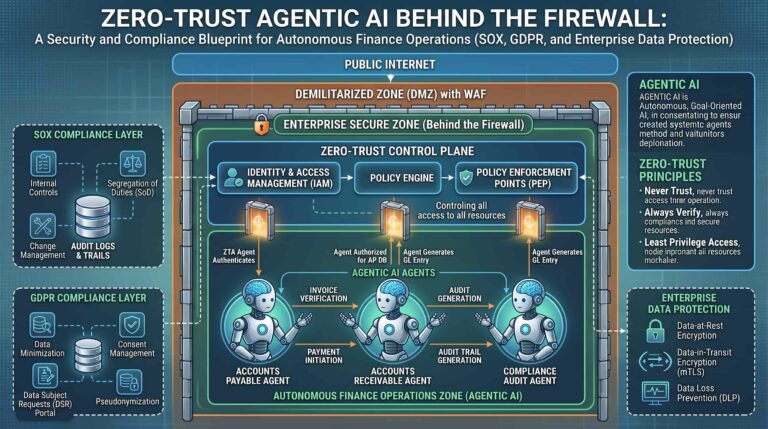
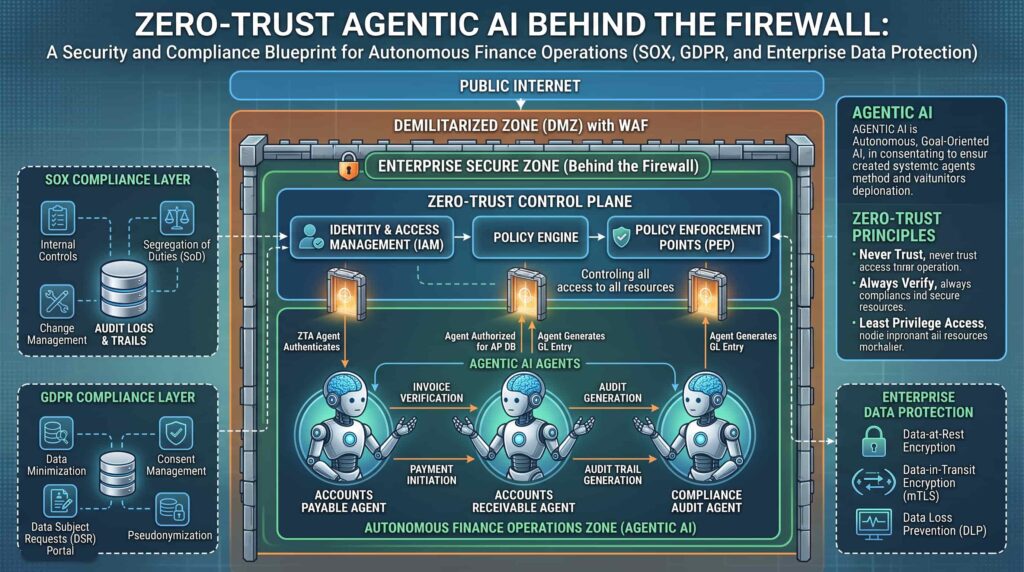
- Identity-First Access via Per-Agent Certificates: Shared service accounts are obsolete. Every individual AI agent must be assigned a unique digital identity backed by a per-agent cryptographic certificate. This ensures that continuous verification is tied to one specific, accountable identity. When multiple agents collaborate to complete a financial reconciliation, agent-to-agent mutual TLS ensures both sides authenticate each other before exchanging sensitive data.
- Policy-as-Code and Explicit Boundaries: Security, access rights, and governance rules must be translated into version-controlled Policy-as-Code. These rules define exactly what an agent is authorized to read, process, and execute. If an agent attempts to access data outside its explicit capability manifest, the request is blocked at the API Gateway level—even if the agent is operating deep inside the internal network.
- Continuous Behavior Validation: Trust is earned dynamically. Zero trust requires ongoing behavior monitoring that evaluates network interactions, activity patterns, and data retrieval volumes in real time. If an agent’s risk profile suddenly changes—for instance, pulling an unusually large dataset from the ERP—its access is instantly tightened or revoked.
Meeting Regulatory Mandates: SOX and GDPR
Deploying agentic AI in finance introduces strict regulatory obligations regarding who (or what) makes decisions and how data is handled. Zero Trust provides the auditable framework required by regulators.
SOX Compliance: Auditability and Human Checkpoints
The Sarbanes-Oxley Act (SOX) requires strict internal controls and verifiable audit trails for financial reporting. Agentic Zero Trust ensures that every high-impact action—such as authorizing a vendor payment or altering a ledger entry—carries irrefutable proof of authority.
- Real-Time Action Logging: Every query, input, data access, and output generated by an agent is logged with full context.
- Threshold-Based Approvals: For high-impact financial transactions, Policy-as-Code dictates that the agent can only prepare the transaction; execution strictly requires human authorization, maintaining the separation of duties mandated by SOX.
GDPR and Enterprise Data Protection
Under GDPR, particularly Article 22 governing automated decision-making, organizations must be able to explain how an AI reached a conclusion and prove that consumer data was protected.
- Minimization at the Source: Zero trust restricts agent access to only the specific data fields necessary for the immediate task, enforcing data minimization.
- Auditable Decision Trees: Because every data retrieval is explicitly verified and logged, compliance teams can instantly generate logs showing precisely what data an agent used to make a credit or payment decision, satisfying regulatory demands for transparency.
Autonomy in finance does not have to mean a loss of control. By treating every AI agent as an unverified identity by default and enforcing Policy-as-Code at every interaction point, CFOs and CISOs can unlock the speed of agentic AI without compromising enterprise data or regulatory compliance.